
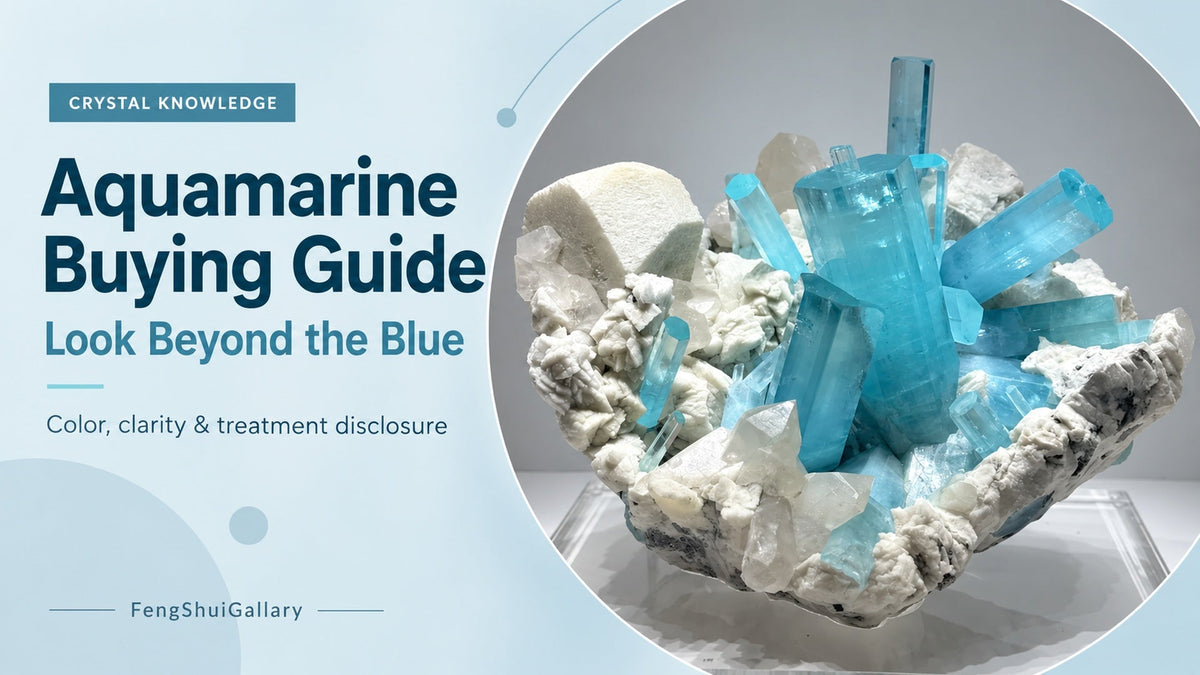
CRYSTAL KNOWLEDGE · A BUYER’S GUIDE
A beautiful blue catches your eye. The details tell you what you are buying.
Aquamarine appears in everything from pale, softly clouded bead bracelets to bright, transparent rings. Add names such as “icy,” “milky,” and “Santa Maria,” and comparing two pieces can quickly become confusing.
This guide follows the questions that matter: what aquamarine is, what the names describe, how to compare quality, and how to approach treatment and authenticity claims without relying on a single visual trick.
01 / THE MATERIAL
Aquamarine is beryl, not quartz
Aquamarine is the greenish-blue to blue variety of beryl, the mineral family that also includes emerald. In everyday shopping, “crystals” may describe a broad group of stones; it does not mean every item is quartz. GIA’s aquamarine description explains the mineral distinction.
Its appeal is easy to understand: a light blue can feel fresh and understated, while a stronger blue makes a more noticeable centerpiece. That appeal does not establish a universal price trend, and celebrity use is not evidence that an individual piece is rare or a good investment.
For a meaningful comparison, focus on the actual gemstone, its condition and the details the seller can substantiate.
02 / UNDERSTANDING THE NAMES
“Icy,” “milky,” and Santa Maria: ask what the seller means
Some sellers use “icy” for a clearer appearance and “milky” for a softer, cloudier look. Treat these as descriptions of appearance, not as separate mineral species or transferable laboratory grades.
Other names in this market vocabulary include “Devil Blue,” “Black Sparkle,” “Crushed Ice,” and “Blue Sky and Clouds.” A name alone does not identify the inclusions, establish natural origin, or explain how a stone was processed. Ask the seller to translate it into observable details.
For a clear appearance
Request photographs against both light and dark backgrounds. Check whether the same beads remain transparent as the bracelet turns.
For a cloudy appearance
Decide whether you enjoy the texture. Do not assume a poetic description makes that texture a rare or superior quality.

Santa Maria deserves the same scrutiny. If the label is being used to claim a particular mine, request evidence of origin. If it describes color, ask to compare the actual color. GIA cautions that a famous mine name does not make an aquamarine valuable by itself; it also notes that aquamarine has no universal quality-grading scale. Read GIA’s buyer’s guide.
03 / COMPARING QUALITY
Look at color, clarity and workmanship together
GIA identifies blue to slightly greenish-blue stones with stronger color as desirable, and notes that most faceted aquamarines are eye-clean. Material with visible inclusions is often fashioned into beads, cabochons or carvings. That is a cutting tendency—not proof that clear beads cannot be genuine. See GIA’s quality factors.

Color: compare the same lighting
Ask for a neutral, unfiltered view and a short video in ordinary daylight. A dramatic photograph may show what you like about a piece, but it is a poor basis for comparing two sellers using different lighting. Do not turn “darker” into an automatic rule for “better.”
Clarity: distinguish preference from the sales claim
You may prefer a soft, cloudy bracelet to a transparent one. That is a valid aesthetic choice. The problem arises when a seller charges for exceptional transparency that the actual bracelet does not show. Inspect close-ups and ask about obvious fractures rather than judging from a distant photograph.
Size and finish: measure before comparing
For bracelets, confirm bead diameter in millimeters, the number of beads, and the finished fit. Compare like with like. A larger bead does not compensate for poor polish, uneven matching, chipped drill holes or an unclear material description.

A surprisingly low price for a combination of strong color, high transparency and large beads is a reason to investigate. It is not enough, on its own, to declare a piece fake.
04 / MEANING & WEARING
A March birthstone with a personal meaning
Aquamarine is a March birthstone, and its name refers to seawater. Its historical associations include protection and intellect. These belong to the stone’s cultural story, not to a guarantee of what wearing it will do. Explore GIA’s history and lore.
In contemporary crystal symbolism, aquamarine is associated with the throat chakra and with communication. Teachers, speakers or anyone preparing for a difficult conversation might choose it as a personal reminder to slow down and express themselves thoughtfully. This symbolism is not evidence that the gemstone improves speech, health or professional performance.
For a gift, a simple message is often enough: calm, courage, or the wish to be heard. Let the meaning stay personal.
05 / PROCESSING & DISCLOSURE
Ask about treatment without confusing it with imitation
Cutting, polishing, treatment and imitation describe different things. Cutting and polishing shape a stone. A treatment changes some aspect of the material’s appearance or condition. An imitation is another material offered to resemble it.
Heating and filling are different processes
Heating can make aquamarine appear bluer. GIA’s care guidance also acknowledges fracture-filled aquamarine, but describes it as rare. That does not support a blanket claim that almost all aquamarine must be resin-filled. Nor does it establish a percentage for any particular bead supplier. Color and heating · Filling and care

If filling is disclosed, ask what material was used, what was filled, and what the report says. Do not accept “a little glue is always a normal improvement” as a substitute for an item-specific description. Likewise, a claim citing a national standard should identify the applicable clause and how it applies to that treatment.
Dyeing, coatings and chemical claims
If a seller mentions dye, coating or chemical cleaning, ask for clear disclosure before deciding whether the item suits you. You cannot determine a dye’s ingredients, residual chemicals or a resin’s safety from its color, a photograph, or the word “industrial.” Claims that every treated item is dangerous—or that every filling is harmless—go beyond what those observations establish.
A treated aquamarine and an imitation should not be confused. The purchasing issue is whether the material and any treatment are represented honestly. If an item is sold as untreated, ask what evidence supports that claim.
06 / PRACTICAL CHECKS
Use a magnifier to ask better questions
Home observation is useful for noticing details. It is much less reliable for assigning a mineral identity or proving a treatment history.
Check color across the whole piece
Notice whether color appears concentrated near a crack or hole, and request a clearer view if it does. Record what you can actually see. Do not conclude “dyed” simply because a feature looks blue, or “natural” because the overall color looks gentle.
Look closely at inclusions
Aquamarine may contain liquid inclusions or long tubes. Such features require interpretation; they are not a beginner’s pass-or-fail test. The absence of visible inclusions does not establish glass, and a bubble-like feature needs examination in context. GIA’s discussion of clarity.
Inspect polish, cracks and drill holes
Look for chips, rough areas and surface-reaching fractures. A network of marks is not enough to prove acid treatment; a glossy or “plastic-like” impression is not enough to prove a coating. These observations help you assess condition and decide what needs professional examination.
Read the report, not just the word “certified”
Check the issuing laboratory, report number, item description, measurements and treatment comments. GIA’s identification reports distinguish natural from laboratory-grown material and identify detectable treatments. A report still needs to match the item in front of you. About aquamarine identification.
For a bracelet, ask whether the report covers the complete strand or only a tested bead. If a valuable claim remains unresolved, arrange appropriate testing before the return period ends. No attractive trade name can replace that clarity.
YOUR QUESTIONS
Aquamarine FAQ
1. How can I tell whether aquamarine is real?
Color and a home magnifier cannot confirm aquamarine on their own. Ask for a clear material description and treatment disclosure, and consider an independent gemological report for a significant purchase. Match the report to the exact stone or bracelet; a report for one bead does not automatically cover the entire strand.
2. Does treated aquamarine count as fake?
Treatment and imitation are different. A treated aquamarine can still be aquamarine, but it should not be sold with unsupported claims that it is untreated. Ask which treatment was used, what evidence supports that description, and whether special care is needed.
3. What should I look for when buying an aquamarine bracelet?
Compare the bracelet in ordinary light, then check bead diameter, transparency, matching, polish and the condition around drill holes. Ask about treatments and returns. Choose the appearance you enjoy, and do not pay a premium for a trade name without evidence of the quality being claimed.
EXPLORE THE DETAILS
Aquamarine in everyday bracelet designs
Prefer a floral detail, a symbolic charm or a mix of gemstones? These four designs are part of our Bracelet collection. Read each listing for its specific materials and dimensions, and ask about treatment information for the piece you are considering.


Photography supplied for this article illustrates appearance and design. The pictured specimens and jewelry have not been authenticated from the photographs. Gemological references are linked beside the relevant discussion; cultural meanings are presented as beliefs.


0 comments